




NEW
Community Platform
Your kit includes free access to our Community Clubhouse platform. Available as an app or website - access new drops, downloads, and a buzzing community of makers!
What's Inside The Clubhouse



Midnight Sky Guide & Tutorials
Welcome to the guide for your MIDNIGHT SKY Moss Coaster Kit!
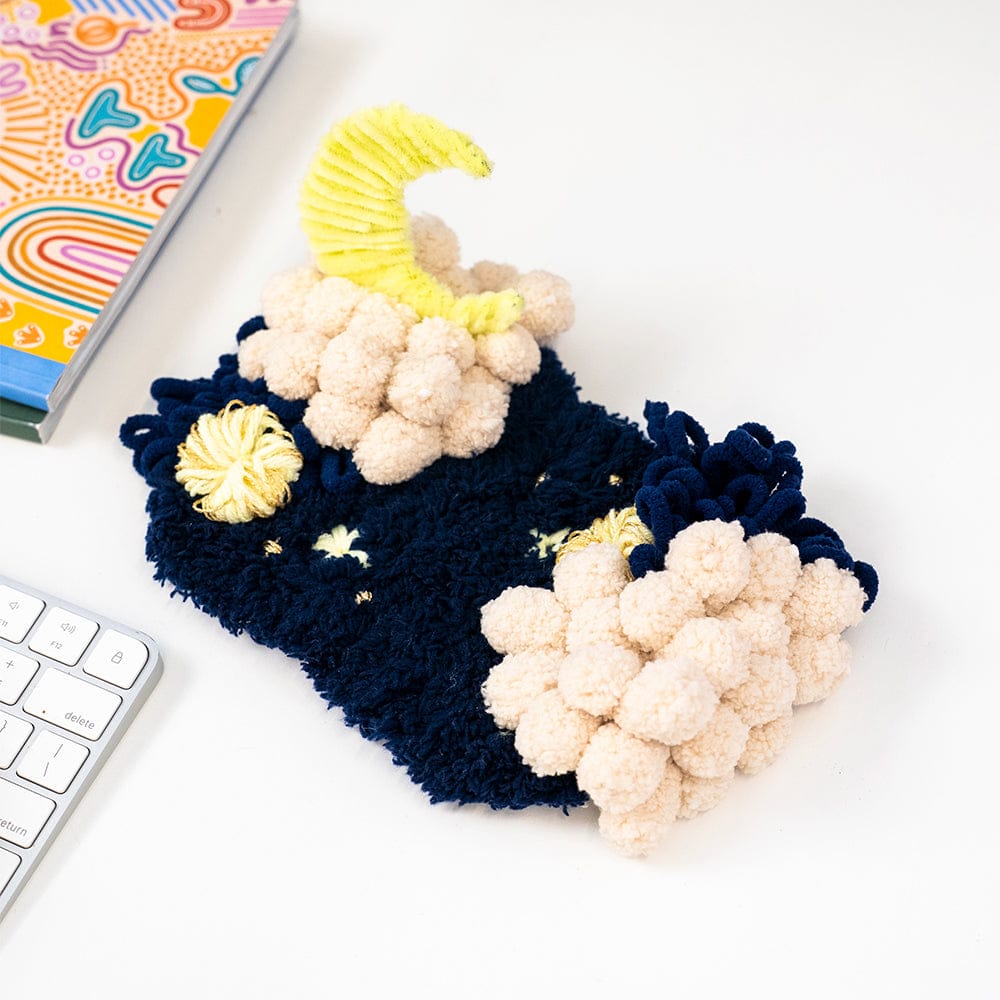
This kit has everything you need to craft a cosy little nightscape — complete with fluffy clouds, twinkling stars, and a glowing crescent moon rising above a deep navy sky. The soft textures and gentle colours come together to create a peaceful, celestial scene you can admire day or night. 🌙✨☁️
Inside Your Kit
Your moss kit includes ...
Materials & Fibre:
- Bobble yarn in soft cream
- Chenille yarn in deep blue
- Feather yarn in deep blue
- Milk yarn in soft yellow
- Metallic floss in bright gold
- Pipe cleaners in celestial yellow
- Pressed felt in white
- Latch-hooking canvas base
- Pattern template
Optional additions:
Our kits come with everything needed to sew the coaster backing on, but you may want to use fabric glue or hot glue if you have it handy.
You may also want to use sharp craft scissors for cutting your base. Our embroidery scissors are perfect for this project because they're small but have a sharp blade.
Midnight Sky Guide
Below you'll find each of the steps to making your Midnight Sky coaster, with recommendations on the order to stitch each element. If you're a newbie to crafting it will be worth following this step-by-step, so that you can get comfortable with the techniques and tools used in this kit.
But if you want to create your own variations, you're more than welcome to stitch each section in whichever order you want! Don't feel constrained by our guidelines.

Step 1: Bobbles (using soft cream bobble yarn)
Step 2: Fuzzy Loops (using deep blue chenille yarn)
Step 3: More Bobbles (using soft cream bobble yarn)
Step 4: Feather Yarn Grass (using deep blue feather yarn)
Moving onto your decorative elements ...
Step 5: Embroidered Details (using soft yellow milk yarn and bright gold metallic floss)
Step 6: Pom Poms (using soft yellow milk yarn and bright gold metallic floss)
Step 7: Pipe Cleaner Crescent Moon (using celestial yellow pipe cleaners)
You can also use the image below to see the details of each element on your coaster.


Midnight Sky Walkthrough
Below is a video that will walkthrough the creation of your moss coaster. This video will show you the process, but it won't include detailed tutorials. So if you're new to making moss coasters - keep scrolling to see the full video tutorials for each technique below.
This video is intended to be a relaxing walk you through of each step in your moss coaster, so that once you know the techniques you can craft along with us.
Step-By-Step Tutorials
This guide will walk you through each step of your moss coaster, and include video tutorials for each technique you will need to learn. If you're already familiar with the techniques used for moss kits, you may just want to watch our walkthrough video (shown above) without needing to dive deeply into each step.
First Things First - Transferring your Stencil
Your first step in creating your moss coaster is to transfer your coaster design from the stencil onto your latch-hooking canvas. To do this you'll need your canvas and a marker of some kind. We recommend using a sharpie or similar permanent marker, but a regular pen or drawing marker will work just fine.
Simply lay the canvas on top of your stencil and use the marker to trace the design behind it. The stencil matches our design with the smaller shapes roughly indicating where we will stitch each type of 'moss' in the following steps.
Feel free to get creative with the shape of your design, as your coaster doesn't have to be exactly like the stencil. You could make it a little larger or smaller depending on how you'd like to use it. Just remember to leave a 1/2 inch space between your coaster shape and the edge of the canvas.
TIP: Why not move the smaller shapes around within your coaster? You can get creative with the layout.
1. Bobbles
The first step in creating your coaster is to fill in the bobbles using your soft cream bobble yarn. You'll be using the technique below to fill in the shape at the top left side of your coaster.
Note: This coaster has been designed to have a smaller flat surface area because the bobble textures are so lush, so its best suited for smaller mugs or cups. Bobble stitching often results in the yarn softly spilling over the edge of the shape you're filling. If you're planning on using your coaster for a larger mug, I recommend stitching your edge bobbles a few squares away from the true edge of your template shape. This will mean that the bobbles stay within the shape and don't cover too much of the blank area in the middle of your coaster.
Check out the video below to learn the technique.

2. Fuzzy Loops
Next you're going to fill multiple spaces on your coaster with Fuzzy Loops using your deep blue chenille yarn. This technique is quite fun and creates a really beautiful looping effect on your coaster. You'll be stitching your fuzzy loops onto the top left shape and the bottom right shape (just below your existing bobbles!).
Watch the video below to learn the technique.
3. More Bobbles
You're almost complete with the most textured elements of your coaster. Now it's time to add some extra bobbles using your soft cream bobble yarn. Use the same technique as step 1 to fill in the last space remaining, on the lower right side of your coaster (under your fuzzy loops).
If you need a refresher of the technique, scroll back up to step 1.
4. Weaving your Feather Yarn Grass
Now it's time to weave in the 'grass' on your mossy coaster - although this time it's probably more appropriate to call it 'sky'! Because this coaster has quite a few decorative elements, we've kept the feather yarn section nice and simple, allowing the rich and deep blue to cover the entire space.
Using your deep blue feather yarn, use the technique in the video below to cover entire remaining space on your coaster. It's worth taking the extra time to weave under any bobble or latch-hooked yarn sections so that you can ensure the coaster is entirely covered.
Follow the below video tutorial to learn how to weave your grass section. Its a very simple technique, using your weaving needle you'll be stitching back and forth to cover the canvas section.
5. Embroidered Details
Now that your coaster base is entirely covered, it's time to add the magic to this midnight blue design! You'll begin with some embroidered flower details, followed by metallic gold stars.
Embroidered Flowers
Using your light yellow milk yarn you'll be stitching 2x lazy daisy flowers with 5x petals each. You can create yours with more/less petals if you want to change the look.
Metallic Stars
Using your metallic gold thread you'll be stitching a few shapes next to your embroidered flowers, according to the diagram at the beginning of this guide. You'll be stitching a combination of cross-shapes and french-knots. Both are quite easy, but metallic yarn requires a slightly different technique to stitch so check out the tutorial below to ensure you're doing it correctly.
6. Pom Poms
The next decorative detail is a few sparkly little Pom Poms to really add some dimension to the coaster.
Watch the video below to learn to make pom poms and their variations. Then follow along with the yarn colour and sizing if you'd like your pom poms to look exactly like our finished coaster.
2x Small Looped Pom Poms using Yellow Milk Yarn & Metallic Gold Thread - These pom poms are quite easy to make because they require minimal snipping. Looped pom poms are much better suited to metallic thread because they hold their shape and aren't at risk of unravelling.
To create your small looped pom poms, start by placing a 15cm length of yellow milk yarn between your pointer and middle finger, then wrap a strand of yellow and metallic yarn around your two fingers approximately 15x. Remove your pom pom from your finger carefully as metallic yarn can come loose more easily, and tie tightly with your length of yellow yarn.
Placement on Coaster: Your finished pom poms can be placed anywhere on your coaster, but if you want to recreate our coaster exactly you'll want to place one pom pom on the lower left side of your design just below the fuzzy loops. The other pom pom will go on the middle right side of your design, nestled between the fuzzy loops and the bobbles.
TIP: You can really get creative with your pom poms! Feel free to mix up the colours of milk yarn and the pom pom techniques you use to make this coaster your own.

7. Pipe Cleaner Crescent Moon
You've reached the final decorative step! It's time to add the shining star (or should I say moon!) onto your magical coaster. We've developed a unique pipe-cleaner-only method of creating a beautifully shaped crescent moon and we're so excited to share it below in our video tutorial.
You'll need between 6-8x celestial yellow pipe cleaners to complete your crescent moon, but our includes a few extra just in case you make any mistakes.

Backing your Coaster
Congratulations on finishing the main part of your coaster! Now you're onto the home stretch, its time to work on the back of your coaster.
There are 2x steps to finishing your coaster, which we show in the below tutorial. First you'll need to roughly trim the canvas edging and sew it down to the back of your piece.
Then it's time to back your coaster with your felt either with glue or by sewing it. If you're using it as a decor piece or to hang on the wall, it may be better for you to leave it at it's current stage. It will be easier to hang on a wall hook if the back is free from felt.
Sewing your Backing
Our kit includes all of the supplies you need to sew the backing of your coaster.
To sew your fabric you'll want to trace the shape of your coaster so that you can cut out the felt fabric to match the shape. You can do this with a pencil or pen.
You will then need to pin your felt backing to your coaster so you can begin sewing the edges. You can do this by using sewing pins, bulldog clips or even tacking the back with a hot-glue gun. I find bulldog clips the easiest method of holding my coaster to the felt.
Using 3-strands of your cotton thread, begin stitching your canvas to your mossy coaster using a whip stitch. This just means that you will whip your thread around and around the edge of your coaster as you go around. Don't worry if your stitches don't look perfectly neat, they'll blend into the grass on your coaster and won't be visible when you're finished.
Gluing your Backing
If you have any fabric glue handy or a hot glue gun then you can also glue the backing of your coaster. We've included a glue stick for a standard craft hot glue gun, as well as a glue paddle if you have fabric glue.
To glue your fabric you'll simply place fabric glue across the middle of your felt square and place your coaster on top. Allow it to dry so that the coaster is secure - you may want to put a heavy book on top of your coaster to add pressure. Once it's dry you can take a sharp pair of scissors to cut around the coaster.
You can then top up the glue on the edges, if any sections are lifting up.